
HDC complaint or Council notification · All 18 responsible authorities
Dignity and Non-Discrimination Course for NZ Healthcare Professionals
CPD course for Health Practitioners facing a Council or Board investigation, complaint or allegation
Which of these is your situation?
- Racism — a remark, a joke or a decision about a patient or a colleague because of their ethnicity
- Cultural safety — a request for karakia, for whānau or for te reo Māori dismissed
- Discrimination — care given, delayed or refused differently because of who the patient is
- Bias — an assumption about drug use, mental health, weight or housing that lowered care
- Dignity — privacy, exposure or who was present during an examination or care
- Language — no interpreter, or a relative used to interpret
- Colleagues — discrimination, bullying or harassment of a colleague, or silence when you saw it
- Beliefs — a personal or religious view that shaped a patient’s advice or care
- Investigation — under a Council or Board process and asked to show insight and remediation?
- CPD — looking for a CPD course after a Council or Board notification to put forward as remediation?
Facing a concern like this — from the Health and Disability Commissioner, your employer, your Council or Board, a Professional Conduct Committee or the Health Practitioners Disciplinary Tribunal?
Help with an HDC complaint or a Council or Board investigation starts here. This CPD course helps you remediate — and demonstrate the remediation, with a dated certificate for your written response, your portfolio or your recertification record.
Ensuring Dignity and Non-Discrimination is written for New Zealand health practitioners registered under the Health Practitioners Competence Assurance Act 2003, to the standards of the Medical, Nursing, Midwifery, Dental and Pharmacy Councils and the other Councils and Boards.
- 2 CPD hours
- Self-paced
- Every registered profession
- CPD certificate
- From NZ$140 a course (Bulk Buy of 10)
 Dr Shehzad IqbalFounder, course author and facilitatorMBBS, MRCS, MRCGP
 Dr Mo MirzaCourse facilitatorMedically trained, UCL London
 Ludmila UpenieceBusiness development and supportPsychology, UEL London
In short: Ensuring Dignity and Non-Discrimination is an online cultural safety and non-discrimination CPD course for healthcare professionals in New Zealand facing a Council or Board notification, complaint or investigation, or an HDC complaint, about discrimination, bias or cultural safety, and for CPD. It is self-paced, 2 CPD hours, NZ$200 (NZ$140 with Bulk Buy 10), with a dated certificate issued on completion for your written response, your portfolio or your recertification record. Immediate access after purchase, twelve months to complete.
At a glance
- Course name
- Ensuring Dignity and Non-Discrimination for Healthcare Professionals — the name on your certificate
- Who it is for
- Any registered practitioner facing an HDC complaint, a Council or Board notification, an employer’s investigation or a Professional Conduct Committee investigation about how a patient, whānau or colleague was treated — racism, discrimination, bias, care that was not culturally safe, a lack of dignity or privacy, interpreters, or bullying or harassment of a colleague — and practitioners taking it as CPD
- Authorities covered
- All 18 responsible authorities under the Health Practitioners Competence Assurance Act 2003, their Professional Conduct Committees and the Health Practitioners Disciplinary Tribunal, and complaints to the Health and Disability Commissioner
- Length
- 9 sections, 58 lessons, 2 CPD hours
- CPD
- 2 hours of learning for your recertification or professional development record
- Format
- Self-paced, online, immediate access, twelve months from purchase
- Certificate
- Certificate issued by Healthcare Ethics New Zealand, part of Healthcare Ethics Courses on completion, dated, with the course title and 2 CPD hours
- Written by
- Dr Shehzad Iqbal, MBBS, MRCS, MRCGP, Postgraduate Certificate in Healthcare Law and Ethics, who also reviews it
- Price
- NZ$200 · from NZ$140 a course (Bulk Buy of 10)
Certificate issued by Healthcare Ethics New Zealand, part of Healthcare Ethics CoursesRemediation courses for regulatory processes.
The certificate you will receive
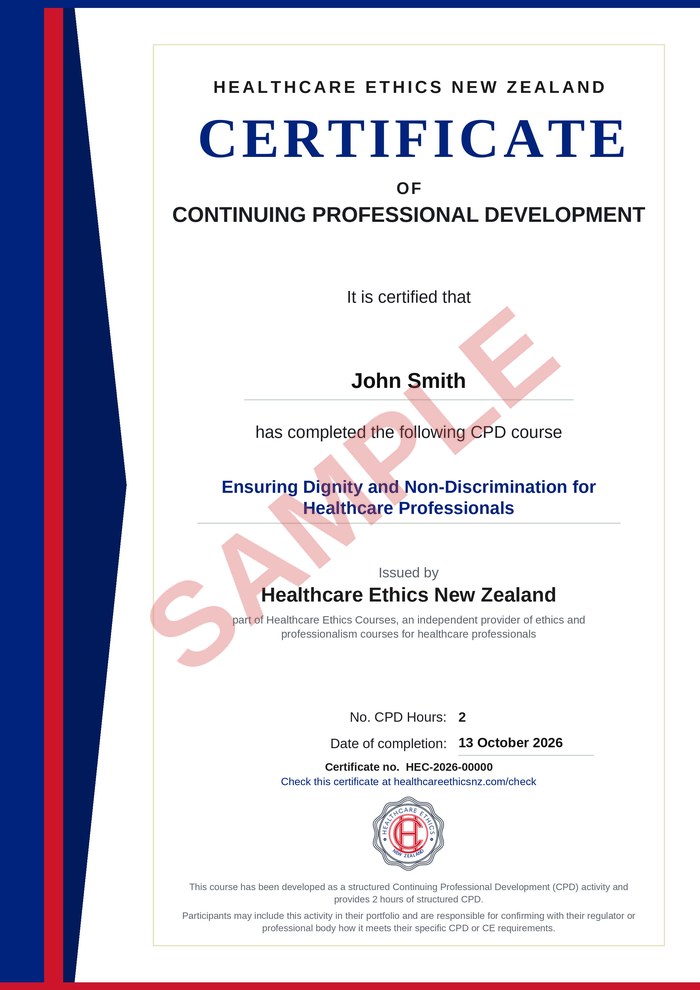
How practitioners use it
- For a response to the HDC or a Council or Board notification, with a reflection piece
- In a portfolio for a Professional Conduct Committee investigation or a Tribunal hearing
- As evidence of remediation in a CPD or recertification record
- As cultural safety learning in your professional development record for the year
Who this course is for
Facing a complaint about racism or discrimination
A patient, a whānau member or a colleague says they were treated less favourably because of their ethnicity, religion, disability, sexual orientation or another part of who they are. Right 2 of the Code of Rights gives every consumer the right “to be free from discrimination, coercion, harassment, and sexual, financial or other exploitation.” This course shows you how to answer the complaint by examining the episode, not by defending your character, and how to show what has changed.
An HDC complaint that a patient’s cultural needs were ignored
A request for karakia refused, whānau turned away, te reo Māori or an interpreter not offered. Right 1(3) gives every consumer the right to services that “take into account the needs, values, and beliefs of different cultural, religious, social, and ethnic groups, including the needs, values, and beliefs of Māori.” The Commissioner has found breaches of Right 1(3), and has written: “It is not sufficient for providers to have policies and protocols regarding cultural support pathways.”
A Council or Board notification about comments to or about a colleague
A remark about a colleague’s accent, faith or ethnicity, a joke in the staff room, a post online or a message in a group chat. In a 2020 case reported in Kaitiaki Nursing New Zealand, the Tribunal found professional misconduct where a registered nurse had posted comments on a nurses’ Facebook page describing Māori nurses and managers in her region as lazy, dishonest and unprofessional; with a second charge also upheld, her registration was cancelled.
A complaint that your care was different because of who the patient is
Pain treated as drug-seeking, symptoms put down to weight or mental health, a patient without stable housing not offered follow-up. Good Medical Practice says: “You must not refuse or delay treatment because you believe that a patient’s actions have contributed to their condition.” The Nursing Council’s Code says: “Do not prejudice the care you give because you believe a health consumer’s behaviour contributed to their condition.” The course gives unconscious bias, and the assumptions that lower the standard of care, a lesson each.
Your employer is investigating, and a notification may follow
A complaint from a patient or a colleague, a workplace investigation into bullying or harassment, a letter from your manager. A complaint to your employer can lead to a workplace process and to a notification to your Council or Board, which receives concerns about a practitioner’s conduct. The course covers bullying and harassment of colleagues, using WorkSafe’s definition, and the remediation that answers both processes.
Under investigation by a Professional Conduct Committee
Your Council or Board has referred questions about your conduct to a Professional Conduct Committee of two registered practitioners and a lay person. It investigates, and it can take no further action, make recommendations to your Council or Board, or lay a charge before the Health Practitioners Disciplinary Tribunal. Your written response, and the insight and dated remediation behind it, are what this course helps you build.
Recording it as cultural safety CPD for your recertification
The course is written as remediation; it can also be recorded as CPD. Several Councils and Boards build cultural safety into recertification. The Medical Council’s strengthened recertification requirements for vocationally registered doctors say: “Cultural safety and a focus on health equity must be embedded within all of the above activities.” The Nursing Council’s recertification audits use its 2025 standards, which include a cultural safety pou. MyRecert asks pharmacists to document the action they have taken towards cultural safety. The Physiotherapy Board’s recertification programme asks for one reflection specific to Māori culture and how it relates to your practice. The Chiropractic Board asks for an identified cultural or diversity responsiveness activity every two years, and ODOB asks optometrists and dispensing opticians for at least one cultural safety credit in each two-year cycle (this course carries no ODOB credits). The certificate records 2 CPD hours on cultural safety, dignity and non-discrimination, with the course title and the date, for your recertification record.
The concerns this course speaks to
Racism: individual, institutional and in the record
A remark or a joke, a lower expectation of a patient or a colleague, a rule that produces worse access for some groups, a label written once and read by everyone after you. The Nursing Council’s standards for registered nurses include: “Challenges racism and discrimination in the delivery of nursing and health care.” The Medical Council’s statement on cultural safety asks doctors to understand “how our colonial history, systemic bias and inequities have impacted Māori and Māori health outcomes, and ensuring that your interactions with and care of patients do not perpetuate this.” Racism has a lesson of its own, with a real HDC decision.
Care that was not culturally safe
A request for karakia refused, whānau kept out of a decision the patient wanted them in, tikanga not asked about, a person made to feel that their culture was a problem. The Nursing Council’s definition: “Cultural safety is the effective nursing practice of a person or family/whānau from another culture and is determined by that person or family/whānau.” The person decides, not your intention, and the course’s second section and first case study work through what that means in practice.
Discrimination, and a different standard of care
Less time, less explanation, a later appointment, fewer tests or less pain relief than another patient with the same need. The Human Rights Act 1993 makes it unlawful for anyone who provides services to the public to treat a person less favourably because of a prohibited ground, and clause 4 of the Code of Rights takes its meaning of discrimination from that Act. The course teaches the question that answers this kind of concern: would another patient with the same presentation have been treated the same way?
Unconscious bias, and the assumptions that lower care
Diagnostic overshadowing, pain treated as drug-seeking, a missed appointment recorded without asking why, a psychiatric history that made an account seem less reliable. The Pharmacy Council’s Competence Standards include “Analyses how embedded biases may negatively influence health outcomes”, and the Physiotherapy Board asks physiotherapists to “consider the impact of their own identity, beliefs, values or cultural biases on kiritaki”. Unconscious bias does not excuse unequal care; the course shows how to find it in your own decisions.
Dignity and privacy in examination and care
An examination without a screen, a person left uncovered, a conversation held across the bed, a comment on someone’s body that was not clinical: a boundaries breach with a patient or a colleague. Right 3 gives every consumer the right to services provided “in a manner that respects the dignity and independence of the individual”, and Good Medical Practice says: “Make sure you treat patients as individuals and respect their dignity and privacy.”
Interpreters, te reo Māori and New Zealand Sign Language
A relative used to interpret a diagnosis, consent taken in English from someone who did not follow it, a Deaf patient given written notes. Right 5(1) includes, “Where necessary and reasonably practicable”, “the right to a competent interpreter”, and the Medical Council’s guidance on the use of interpreters, which supplements Good Medical Practice, says: “When treating patients with limited English language, you should arrange a competent interpreter.” One of the course’s case studies is an interpreter not arranged.
Discrimination, bullying and harassment of colleagues
Remarks about a colleague’s accent, religion or ethnicity, the least wanted shifts given to the same person, a junior colleague humiliated in front of patients. WorkSafe defines bullying as “repeated and unreasonable behaviour directed towards a worker or a group of workers”; Good Medical Practice says “You must not discriminate against colleagues”; the Physiotherapy Board’s Code asks physiotherapists to “not bully or harass or facilitate or enable bullying or harassment in a workplace or workplace related setting.” The course covers your own conduct and what to do when you witness it.
Personal beliefs and access to care
A religious or moral view that shaped advice, a request declined because of who the person is rather than what they asked for. Good Medical Practice: “Your personal beliefs, including political, religious and moral beliefs, should not affect your advice or treatment.” The Nursing Council’s Code: “Do not impose your political, religious and cultural beliefs on health consumers, and intervene if you see other health team members doing this.” The course sets out the difference between declining a treatment and declining a person.
Facing an HDC complaint or a Council or Board notification? This course helps you remediate — and demonstrate it.
Buy this course — NZ$200 (NZ$140 with Bulk Buy 10)What the course covers
Nine sections and 58 lessons, with a reflective quiz closing every section and a 10-question post-course assessment at the end.
Introduction to Cultural Safety, Dignity and Non-Discrimination
Five lessons and a reflective quiz
Key Concepts: Dignity, Cultural Safety and Te Tiriti
Seven lessons and a reflective quiz
Understanding and Preventing Discrimination
Nine lessons and a reflective quiz
Standards and Expectations in New Zealand
Nine lessons and a reflective quiz
Communication, Dignity and Respect
Six lessons and a reflective quiz
Addressing Breaches
Nine lessons and a reflective quiz
Remediation for Practitioners Facing a Complaint or Notification
Six lessons and a reflective quiz
Personal and Professional Development
Five lessons and a reflective quiz
Conclusion and Key Takeaways
Conclusion, key takeaways and a reflective quiz, then the 10-question post-course assessment
Show every lesson title
- Section 01 · Introduction to Cultural Safety, Dignity and Non-Discrimination
- What Cultural Safety, Dignity and Non-Discrimination Mean in New Zealand Healthcare; Why They Matter to Patients, Colleagues and Your Registration; How a Concern Reaches the HDC or Your Council or Board; Who This Course Is For and How to Use It; The Standards This Course Is Built On.
- Section 02 · Key Concepts: Dignity, Cultural Safety and Te Tiriti
- Dignity and Respect in the Code of Rights; What Cultural Safety Means: From Irihapeti Ramsden to the Councils; The Medical Council’s Definition: Curtis and Colleagues (2019); Cultural Competence and Cultural Safety: Why Both Are Needed; Te Tiriti o Waitangi in Health: The Five Principles From the Hauora Report; Māori Health Equity, Whānau and Tikanga in Everyday Practice; Power, Privilege and Your Own Culture.
- Section 03 · Understanding and Preventing Discrimination
- Direct and Indirect Discrimination, Harassment and Racial Harassment; The Prohibited Grounds and the Wider Expectations in Your Code; Racism: Individual, Institutional and in the Record; Unconscious Bias and How It Shapes Clinical Decisions; Assumptions That Lower the Standard of Care; Disability, Access and Reasonable Adjustment; Gender, Sexual Orientation and Gender Identity; Religion, Belief, Age and Personal Beliefs in Practice; Creating an Inclusive Environment for Patients and Colleagues.
- Section 04 · Standards and Expectations in New Zealand
- The HPCA Act: Section 118(i), the 2019 Amendment and the 2026 Bill; The Code of Health and Disability Services Consumers’ Rights; The Medical Council: Good Medical Practice, Cultural Safety and He Ara Hauora Māori; The Nursing Council: Code of Conduct, the 2025 Standards and Kawa Whakaruruhau; The Midwifery Council: Code of Conduct, Standards of Competence and Tūranga Kaupapa; The Dental and Pharmacy Councils; The Psychologists and Physiotherapy Boards, and the Other Authorities; Human Rights, the Bill of Rights and the Healthy Futures (Pae Ora) Act; What Happens When the Standards Are Not Met.
- Section 05 · Communication, Dignity and Respect
- Verbal and Non-Verbal Communication That Conveys Respect; Language That Demeans: Labels, Jokes and Remarks; Interpreters, Te Reo Māori and New Zealand Sign Language; Whānau, Support People and Speaking to the Patient, Not Around Them; De-escalation, and When Abuse Is Directed at You; Respectful Communication With Colleagues and in the Health Record.
- Section 06 · Addressing Breaches
- Recognising a Breach of Dignity, Cultural Safety or Non-Discrimination Standards; Discrimination, Bullying and Harassment of Colleagues; When You Witness It: Speaking Up, Supporting and Reporting; What a Complaint About Discrimination or Cultural Safety Looks Like at the HDC; How Your Council or Board Assesses the Concern; Case Study 1: Karakia Refused and a Remark About Whānau; Case Study 2: Pain Treated as Drug-Seeking; Case Study 3: An Interpreter Not Arranged; Case Study 4: Remarks About a Colleague’s Accent and Faith.
- Section 07 · Remediation for Practitioners Facing a Complaint or Notification
- Acknowledging the Concern Without Defensiveness; “I Am Not Racist”: Why Denial Answers the Wrong Question; Examining the Episode: Would Another Patient Have Been Treated the Same Way?; Writing a Reflective Statement That Shows Insight; Building a Remediation Plan and Evidence of Change; Apology, Hui ā-Whānau and Professionalism While the Process Runs.
- Section 08 · Personal and Professional Development
- Reflecting on Your Own Culture, Values and Position; A Personal Development Plan for Culturally Safe Practice; Using CPD and Recertification on Cultural Safety and Bias; Supervision, Cultural Supervision, Mentoring and Feedback; Preventing Repetition: Habits That Sustain Respectful Practice.
- Section 09 · Conclusion and Key Takeaways
- Conclusion; Key Takeaways.
How to respond to an HDC complaint or a Council or Board notification
Set out a response to a racism, discrimination or cultural safety concern in four parts, in this order. The HDC, your Council or Board and a Professional Conduct Committee are asking about conduct: what happened, how it compares with the Code of Rights and your standards, and what you have done since. The course teaches each part.
Saying you are not racist answers a question nobody asked.
- Your partWhat you said, did and decided, in the first person — the remark, the request refused, the examination, the interpreter not booked — without explaining it away or describing your character instead.The course’s seventh section opens with acknowledging the concern without defensiveness.
- The episode, examinedDecision by decision: would another patient, or another colleague, in the same circumstances have been treated the same way? That question can be answered honestly without accepting that you hold prejudiced views.The course asks the comparator question in each of its four case studies.
- The person’s experienceHow the patient, their whānau or your colleague experienced it, in their words, and the right or standard named accurately: Right 1(3), 2, 3 or 5(1) of the Code of Rights, and your own Council’s or Board’s code and cultural standard.The course sets out the Councils’ and Boards’ standards side by side.
- The changeAn interpreter booked as routine, whānau asked about and the answer recorded, notes read back for labels, an audit of your own decisions, cultural supervision, feedback gathered through your service — each dated.This course is the dated item you attach — and it names the other evidence.
Cultural safety is decided by the person who received the care, not by the intention of the person who gave it.
Take advice from your indemnity insurer, your union or professional association, or a lawyer before you respond to anyone.
How this course helps if a complaint or notification has been made
Saying “I am not racist” is the response that fails
You may want to say it first: that you are not racist, that you treat everyone the same, that you have cared for people from every background for years. It is sincere, and it does not help, because the HDC and your Council or Board are not deciding what kind of person you are. They are deciding whether your conduct, on a particular day, with a particular patient or colleague, met the standard. The Medical Council’s statement on cultural safety asks doctors “to acknowledge and address any of their own biases, attitudes, assumptions, stereotypes, prejudices, structures and characteristics that may affect the quality of care provided” — a duty to look for your own biases, not to declare that you have none.
Examine the episode, not your character
What answers the concern is the specific episode: what was decided, offered and explained, how long was spent, who was present, what was written — and whether any of it would have been different for another patient or another colleague. Cultural safety adds a second question: how did the person and their whānau experience the care? The course works through both in writing, decision by decision, and suggests testing your answers with a supervisor, or a cultural supervisor or adviser where the concern involves Māori or another community, because your own assumptions are hard to see.
Remediation evidence that counts
Counts: a reflective statement in the first person that names the right and the standard; shorter dated reflections written over several weeks; an apology without conditions, through a hui ā-whānau if the whānau want one; an audit of your own decisions that matches the concern — interpreter use, pain relief by patient group, the language in your notes — repeated after you change; a supervisor’s or cultural supervisor’s report; feedback gathered through your employer or a structured process, never from the complainant; this course’s dated certificate with a reflection on what changed. Counts for little: a statement that you are not racist, a list of the patients or colleagues from other backgrounds you have worked with, a description of the complainant as oversensitive, a list of clinical tasks in answer to a concern about dignity, hours on an unrelated subject. For the stages from the first letter to the Tribunal, see the Council and Board investigation process, explained.
Read the primary sources
- Code of Health and Disability Services Consumers’ Rights — Health and Disability Commissioner
- Health Practitioners Competence Assurance Act 2003 — the Act
- Medical Council — Statement on cultural safety (2019)
- Nursing Council — Te Tiriti o Waitangi, Māori Health, Kawa Whakaruruhau, Cultural Safety guidance (2025)
- Health and Disability Commissioner — Culturally appropriate services (2023)
- Ministry of Health — Te Tiriti o Waitangi framework
- Human Rights Act 1993
Using this course as CPD
Each New Zealand Council and Board sets its own recertification programme: Inpractice or a college programme for doctors, MyMCANZ for midwives, MyRecert for pharmacists, and the plans, logbooks and hours of the other Councils and Boards. This course is 2 hours of learning on cultural safety, dignity and non-discrimination that you can record within yours, with a dated certificate showing your name, the course title, the provider, the date and 2 CPD hours; keep it with your recertification records in case of an audit. Where your programme asks for cultural safety learning or reflection, write a short dated reflection on what you will change in practice and keep it with the certificate.
What each Council and Board asks for in CPD → Courses and recertification for each Council and Board →
Who wrote it

Dr Shehzad Iqbal
Course author and facilitator, Healthcare Ethics New Zealand
Dr Iqbal has designed and delivered ethics, probity and professionalism training for healthcare professionals since 2020, working with registrants across regulated health professions, online and face to face. He combines clinical practice with formal postgraduate training in healthcare law and ethics.
MBBS · MRCS · MRCGP · Postgraduate Certificate in Healthcare Law and Ethics, University of Dundee
Written and reviewed by Dr Shehzad Iqbal. Last reviewed .
About this course
Ensuring Dignity and Non-Discrimination for Healthcare Professionals is a two-hour remediation course, self-paced, for any practitioner facing an HDC complaint, a notification, an investigation or an allegation before one of New Zealand’s 18 responsible authorities about how a patient, whānau or colleague was treated. It covers cultural safety as the Councils and Boards define it; Te Tiriti o Waitangi and the five principles of the Hauora report (Wai 2575); dignity and respect under the Code of Rights; discrimination under the Human Rights Act 1993; racism and unconscious bias; interpreters, whānau and respectful communication; bullying and harassment of colleagues; four case studies; and the reflective statement and dated remediation plan that answer a concern.
What is cultural safety in Aotearoa New Zealand?
Cultural safety is decided by the person receiving care. The idea began in New Zealand nursing education: Dr Irihapeti Ramsden wrote the Nursing Council’s original guidelines in 1991 and led their update in 1996. The Council’s guidance, updated in 2025 and launched in February 2026, defines it this way: “Cultural safety is the effective nursing practice of a person or family/whānau from another culture and is determined by that person or family/whānau.” The Medical Council’s Statement on cultural safety (October 2019) opens: “Cultural safety focuses on the patient experience to define and improve the quality of care.” Its definition, from Curtis and colleagues (2019), asks doctors to examine themselves and the potential impact of their own culture on clinical interactions, and to hold themselves accountable for providing culturally safe care “as defined by the patient and their communities”.
Culture is wider than ethnicity. The Nursing Council’s guidance says: “Broader cultural safety includes, but is not restricted to, age or generation, gender identity, sexual orientation, occupation and socioeconomic status, indigenous status or ethnic origin or migrant experience, religious or spiritual belief and disability.”
Two things are New Zealand-specific. The first is the law: section 118(i) of the Health Practitioners Competence Assurance Act 2003 requires every Council and Board to set standards of “clinical competence, cultural competence (including competencies that will enable effective and respectful interaction with Māori), and ethical conduct”, and Right 1(3) of the Code of Rights names the needs, values and beliefs of Māori. The Health Practitioners Competence Assurance Amendment Bill, introduced in May 2026, would remove the words added in 2019 about interaction with Māori while keeping the duty to set cultural competence standards; it is not law as at October 2026. The second is Te Tiriti o Waitangi: the Waitangi Tribunal’s Hauora report (Wai 2575) set out five principles — tino rangatiratanga, equity, active protection, options and partnership — which the Nursing Council’s guidance, the Physiotherapy Board’s Māori cultural safety standard and the Dental Council’s cultural safety competencies all draw on.
Examples of cultural safety in healthcare
Cultural competence is what you know; cultural safety is how the person experienced your care. None of these is a rule to apply to everyone: ask, offer and record the answer.
Ask who should be present
Knowing that some Māori patients may want whānau present is competence; asking this patient who they want present, and making room for it, is safety. The Medical Council’s statement asks doctors to “Include the patient’s whānau in their health care when appropriate.”
Make time for karakia
A wish for karakia before a procedure or a difficult conversation is a request about care. Offer the pause, and record the request and the answer. A request for karakia refused is the first of the course’s case studies.
Ask before you touch the head
In te ao Māori the head is tapu. Ask before you touch it, keep items that touch the body apart from items used for food, and return body tissue to the person or whānau if they ask. Do not assume any of these applies: ask, offer and record.
Book a competent interpreter
For consent, history, diagnosis and medication instructions, use a competent interpreter, in person, by phone or by video, and a qualified New Zealand Sign Language interpreter for a Deaf person who uses it. A relative can stay as support.
Say the name correctly
Learn how to pronounce a person’s name, ask when you are unsure, and practise. A name repeatedly mispronounced, or replaced with a nickname, tells a person they are not worth the effort.
Write findings, not labels
Write “raised his voice and said he would leave”, not “aggressive and rude”. Do not copy a label such as “known drug seeker” forward from earlier notes without checking the evidence behind it.
Do not assume from ethnicity or faith
The Medical Council’s statement asks doctors to acknowledge “that general cultural information may not apply to specific patients and that individual patients should not be stereotyped.” Ask about needs; do not read them from a name or a country of birth.
Ask for feedback on cultural safety
The Pharmacy Council’s Competence Standards include: “Elicits feedback from person(s) being cared for and/or whānau on cultural safety in practice”. Feedback gathered through your service shows whether the change is experienced by the people you care for.
Discrimination in healthcare: your standards go wider than the law
The codes did not simply adopt the legal categories, and a written response that answers only the law answers only part of the question.
The grounds in the Human Rights Act
Section 21 of the Human Rights Act 1993 lists the prohibited grounds: sex (including pregnancy), marital status, religious belief, ethical belief, colour, race, ethnic or national origins, disability, age (from 16), political opinion, employment status, family status and sexual orientation. Community Law notes that discrimination because of gender identity is treated in practice as falling within sex. Providing services to the public is one of the areas the Act covers.
And your code reaches further
The Nursing Council’s Code: “Practise in a way that respects difference and does not discriminate against those in your care on the basis of ethnicity, religion, gender, sexual orientation, political or other opinion, disability or age.” Good Medical Practice: “Nor should you unfairly discriminate against patients by allowing your personal views to affect your relationship with them.” Neither depends on the conduct being unlawful.
Which is where concerns arise
Assumptions about weight, smoking, alcohol or drug use, housing or a mental health history. Some of these are not named among the grounds in the Act; all of them are inside your code. A Council, Board, Committee or Tribunal does not need a finding that you broke the Human Rights Act before it acts on a concern about disrespect or bias.
Three duties, not one
The first is the duty you will already know. The second and third are where a written response can be incomplete.
01 · Do not discriminate
Good Medical Practice paragraph 41: “You must not discriminate against colleagues.” The Physiotherapy Board’s Code asks physiotherapists to “not discriminate or facilitate or enable discrimination”. Towards patients and colleagues alike.
02 · Look for your own bias, and address it
The Nursing Council’s Code, standard 2.4: “Reflect on and address your own practice and values that impact on nursing care in relation to the health consumer’s age, ethnicity, culture, beliefs, gender, sexual orientation and/or disability”. The Pharmacy Council: “Addresses biases within area of pharmacist practice”. Awareness alone is not the duty; addressing it is.
03 · Act on what you see in others
The registered nurse standards: “Challenges racism and discrimination in the delivery of nursing and health care.” The Psychologists Board’s Code of Ethics: “Psychologists seek to prevent or correct practices that are unjustly discriminatory.” The Medical Council asks doctors to consider “Challenging the cultural bias of individual colleagues or systemic bias within health care services”. Silence is a position your Council or Board can examine.
What these words mean
The four terms that matter most here, and the other words the course uses.
- Cultural safety
- The Nursing Council’s definition: “Cultural safety is the effective nursing practice of a person or family/whānau from another culture and is determined by that person or family/whānau.” The Medical Council’s statement, from Curtis and colleagues (2019), asks practitioners to hold themselves accountable for providing culturally safe care “as defined by the patient and their communities”. Either way, the person who received the care decides.
- Discrimination
- Clause 4 of the Code of Rights: “Discrimination means discrimination that is unlawful by virtue of Part II of the Human Rights Act 1993.” Direct discrimination is treating a person less favourably because of a prohibited ground; the course also explains indirect discrimination, a rule or practice that looks neutral but disadvantages a group. Your code reaches conduct that is not unlawful.
- Professional Conduct Committee
- The committee your Council or Board appoints under section 71 of the Health Practitioners Competence Assurance Act 2003 to investigate questions about your conduct: two registered practitioners and a lay person. It can take no further action, make recommendations to the authority, or lay a charge before the Tribunal.
- Professional misconduct
- The Tribunal’s ground under section 100 of the Act, including an act or omission that “amounts to malpractice or negligence in relation to the scope of practice in respect of which the practitioner was registered at the time that the conduct occurred” or “has brought or was likely to bring discredit to the profession that the health practitioner practised at the time that the conduct occurred”.
Cultural competence, kawa whakaruruhau, Te Tiriti o Waitangi principles, unconscious bias, racism, racial harassment, bullying, whānau, tikanga, hui ā-whānau and the other terms the course uses
- Cultural competence
- What you know and can do. Section 118(i) of the HPCA Act requires each authority to set standards of cultural competence. The Medical Council’s statement says: “While it is important, cultural competence is not enough to improve health outcomes, although it may contribute to delivering culturally safe care.”
- Kawa whakaruruhau
- The Nursing Council describes it as “cultural safety within a Māori context”. Whakaruruhau means to shelter, protect or safeguard.
- Te Tiriti o Waitangi principles
- The five principles from the Waitangi Tribunal’s Hauora report (Wai 2575), as the Ministry of Health’s framework sets them out: tino rangatiratanga (“The guarantee of tino rangatiratanga, which provides for Māori self-determination and mana motuhake in the design, delivery, and monitoring of health and disability services.”); equity, “which requires the Crown to commit to achieving equitable health outcomes for Māori”; active protection; options; and partnership. The Nursing Council’s guidance calls the earlier “three Ps” “generally considered outdated”.
- Unconscious bias
- An attitude or association that affects judgement without the person being aware of it, sometimes called implicit bias. The Medical Council asks doctors to develop “an understanding of how your social-cultural influences inform biases that impact your interactions with patients, whānau, and colleagues.” It does not excuse unequal care.
- Racism
- Treating people differently, or holding them in less regard, because of their race, colour, or ethnic or national origins: individual (a remark, a delay, a lower expectation), institutional (a rule or way of working that produces worse access or outcomes) or in the record (a label read by everyone who comes after). It does not need to be intended to cause harm.
- Racial harassment
- Under section 63 of the Human Rights Act 1993, language, visual material or physical behaviour that expresses hostility against a person, or brings them into contempt or ridicule, because of their colour, race, or ethnic or national origins, that is hurtful or offensive to them, and that is repeated or significant enough to have a detrimental effect.
- Bullying
- WorkSafe’s definition: “repeated and unreasonable behaviour directed towards a worker or a group of workers” that can lead to physical or psychological harm. “Repeated behaviour is persistent (occurs more than once)”. A single incident is not bullying under this definition, but it should still be addressed, and it can be harassment or discrimination.
- Whānau
- The Nursing Council’s standards: whānau “is often translated as ‘family’, but its meaning is more complex.” Ask the person who their whānau is and how they want them involved.
- Tikanga
- Māori customary practices. The Nursing Council’s standards explain that to act in accordance with tikanga “is to behave in a way that is culturally proper or appropriate.”
- Hui ā-whānau
- A tikanga-led way of resolving a complaint, which the HDC may suggest. If the patient and whānau want one, take part openly, with support from your employer’s Māori health service or an adviser. The course covers it with apology in its seventh section.
- Reasonable adjustment
- A change to how care is provided so that a person can receive it: a longer appointment, step-free access, a New Zealand Sign Language interpreter, information in Easy Read. Good Medical Practice: “You should make reasonable adjustments to your practice to enable them to receive care that meets their needs.”
- The comparator question
- Would another patient, or another colleague, with the same presentation or in the same circumstances, have been treated the same way? It sets aside the question of your character and examines the episode, decision by decision.
- Insight
- Being able to describe what happened from the other person’s side, name the standard, explain how an assumption may have shaped what you did, and show what you have changed — without minimising it.
- Remediation
- Change someone else can confirm, dated: reflections linked to the concern, a supervisor’s or cultural supervisor’s report, an audit of your own decisions, feedback gathered through your service, and learning that matches the concern.
The rights and standards a cultural safety or discrimination concern engages
A concern about how a patient, whānau or colleague was treated is read against the Code of Rights and against the standards your Council or Board sets under the Health Practitioners Competence Assurance Act 2003. These are the provisions it engages.
Right 1(3) — cultural needs, values and beliefs
Every consumer has the right to services that “take into account the needs, values, and beliefs of different cultural, religious, social, and ethnic groups, including the needs, values, and beliefs of Māori.” In decision 20HDC00354 (2022) the Deputy Commissioner found a breach of Right 1(3) where a Cook Island Māori woman in mental health care did not have her cultural needs assessed at triage and was not offered cultural mental health follow-up, although the service’s own policies required it. Read it.
For this course: Section 2 of the course, and its first case study, are built on this right.
Right 2 and clause 4 — freedom from discrimination
“Every consumer has the right to be free from discrimination, coercion, harassment, and sexual, financial or other exploitation.” Clause 4 gives discrimination the meaning it has under Part 2 of the Human Rights Act 1993. Disrespect that is not unlawful discrimination can still engage Right 1, Right 3 or Right 4, and your code. Read it.
For this course: The comparator question — would another patient have been treated the same way? — is the course’s method for examining the decision this right asks about.
Right 3 and Right 1(1) — dignity and respect
“Every consumer has the right to be treated with respect.” Right 3: the right to have services provided “in a manner that respects the dignity and independence of the individual.” Privacy, who is present, how a person is spoken to and spoken about, and whether they are spoken to at all. Read it.
For this course: Dignity in examination and care, and the language that demeans, have lessons of their own.
Right 5(1) — effective communication and a competent interpreter
“Every consumer has the right to effective communication in a form, language, and manner that enables the consumer to understand the information provided. Where necessary and reasonably practicable, this includes the right to a competent interpreter.” Read it.
For this course: Interpreters, te reo Māori and New Zealand Sign Language have a lesson, and a case study.
Section 118(i) of the HPCA Act — your authority sets cultural standards
Each authority’s function is “to set standards of clinical competence, cultural competence (including competencies that will enable effective and respectful interaction with Māori), and ethical conduct to be observed by health practitioners of the profession”. The words in brackets were added from 12 April 2019. The Health Practitioners Competence Assurance Amendment Bill, introduced in May 2026, would remove them while keeping the duty to set cultural competence standards; it is not law as at October 2026. Read it.
For this course: The course sets out the cultural standards of the Councils and Boards, quoting the Medical, Nursing, Dental and Pharmacy Councils and the Psychologists and Physiotherapy Boards.
Section 100 of the HPCA Act — the grounds of discipline
Professional misconduct includes an act or omission that “has brought or was likely to bring discredit to the profession that the health practitioner practised at the time that the conduct occurred”. The Tribunal found professional misconduct where a nurse posted demeaning comments about Māori colleagues online, and her registration was cancelled; section 101 sets the penalties. Read it.
For this course: Conduct towards colleagues online and in person is read as conduct, and the course explains how.
Also engaged: Right 4(1) — services with reasonable care and skill: the Deputy Commissioner found a breach in 19HDC01783 (2022) for inadequate investigation, with concerns about possible bias · Right 10 — the right to complain, and the provider’s duty to “facilitate the fair, simple, speedy, and efficient resolution of complaints” · Human Rights Act 1993 — section 21 (prohibited grounds), section 44 (goods and services), sections 62 and 63 (sexual and racial harassment) · Medical Council — Good Medical Practice paragraphs 15, 17 to 20 and 41; the Statement on cultural safety and He Ara Hauora Māori (2019) · Nursing Council — Code of Conduct principles 1, 2 and 6; registered nurse standards 2.1 and 2.2; the 2025 cultural safety guidance · Midwifery Council — the Code of Conduct, the Standards of Competence for kahu pōkai | midwives (2024) and Tūranga Kaupapa · Dental Council — Standards Framework standards 3, 4 and 18; the cultural safety competencies · Pharmacy Council — Competence Standards domain 1 and standard 2.3, “Applies culturally safe practice” · Psychologists and Physiotherapy Boards — the Code of Ethics (2002) Principle 1; the Physiotherapy Board’s Code (2026) and its two cultural standards.
How a cultural safety or discrimination concern moves
A concern can start with the HDC, your Council or Board, your employer or the Human Rights Commission, and at every stage the reader asks the same things: what happened, how did the person experience it, would someone else have been treated the same way, and what has changed?
A complaint to the HDC
Right 10(1) gives every consumer “the right to complain about a provider in any form appropriate to the consumer.” A complaint that a practitioner’s practice or conduct affected a health consumer goes to the HDC first, which the Dental Council describes as a “one stop shop”. The Commissioner may ask for an apology, recommend changes, refer the complaint to an advocate or back to you, suggest a hui ā-whānau, refer it to your Council or Board, take no further action, or investigate.
A formal investigation by the Commissioner
You are asked to respond in writing, the Commissioner may take advice from a practitioner in your field, and you can comment on a provisional opinion before the final one. The final report can be sent to your Council or Board, and a breach report can be published with identifying details removed. After a breach finding, the Commissioner can refer a practitioner to the Director of Proceedings, who decides whether to take proceedings before the Tribunal or the Human Rights Review Tribunal.
Your Council or Board
A notification can come from the HDC, a patient, whānau, a colleague or an employer. Your Council or Board reads what happened, the standard, the effect, whether there is a pattern, and what you have done since — and decides on a route, from no further action or a letter of advice to a referral of questions about your conduct to a Professional Conduct Committee.
A Professional Conduct Committee
Two registered practitioners and a lay person investigate. They can take no further action, make recommendations to your Council or Board, or lay a charge before the Tribunal. A response that sees the person’s experience and its own part, with dated remediation behind it, is what the course helps you prepare.
The Tribunal
The Health Practitioners Disciplinary Tribunal hears charges for every profession under section 100 of the Act. In 2020 it found professional misconduct where a nurse posted demeaning comments about Māori colleagues online, and her registration was cancelled.
The Human Rights Commission
Where discrimination or harassment is alleged, a complaint can also go to the Human Rights Commission, which offers dispute resolution, and proceedings can be brought in the Human Rights Review Tribunal. That is a separate process from the one about your registration.
Facing an HDC complaint or a Council or Board notification? This course helps you remediate — and demonstrate it.
Buy this course — NZ$200 (NZ$140 with Bulk Buy 10)This course is written for every registered profession under the Health Practitioners Competence Assurance Act 2003 — the process is the same for all. Ten professions also have Ethics and Professionalism courses written to their own Council or Board’s standard. Find the courses for your profession →
Healthcare Ethics New Zealand is independent and not affiliated with any Council or Board, or with the Health and Disability Commissioner.
Key Takeaways
- What course should I take after a complaint to my Council or Board about cultural safety and dignity? Our cultural safety and dignity course is written for health practitioners facing a complaint or investigation about cultural safety and dignity, and follows your Council or Board's code of conduct, so your reflection can name the part of the code the concern engages.
- Will a cultural safety and dignity course help with my Council or Board investigation? It is evidence of insight and remediation, which a Professional Conduct Committee and your Council or Board look at — strongest with a written reflection and changes in your practice. No course can guarantee an outcome.
- When should I do the cultural safety and dignity course: before my response? As early as you can — before your written response to the Council, Board or Health and Disability Commissioner, so the certificate and your reflection can go with it. It still helps before a Professional Conduct Committee, the Health Practitioners Disciplinary Tribunal or a competence review.
- Can I finish the course before my deadline? Yes — it is online and self-paced, you can start as soon as you book, and the certificate, issued by Healthcare Ethics New Zealand, part of Healthcare Ethics Courses, is available on completion.
- Does the cultural safety and dignity course count as CPD? Yes — it is a CPD course you can record towards your recertification, whether or not a complaint has been made.
- Does this course help with a reflective statement? Yes. It ends with a Reflection Template that helps you plan and structure your reflective writing and your reflective statement.
- Is this course interactive? Yes. Each section ends with an Interactive & Reflective Exercise: you type your answers, then compare them with the points to consider from that section.
Frequently asked questions
Is this course written for New Zealand health practitioners?
Yes. It is written for health practitioners registered in New Zealand under the Health Practitioners Competence Assurance Act 2003, and follows the New Zealand process from a Council or Board notification through a Professional Conduct Committee to the Health Practitioners Disciplinary Tribunal. It refers to the standards of the Medical, Nursing, Midwifery, Dental and Pharmacy Councils and the other Councils and Boards, so you can cite your own authority’s standard.
Can I use this course for my CPD and in my response to a Council or Board complaint or investigation?
Yes, for both. If you are completing a course to meet a condition or an undertaking, check its wording before you count the hours towards your CPD.
For CPD: Each New Zealand Council and Board sets its own recertification programme, and you choose learning relevant to your practice: doctors record it in Inpractice or their college’s programme; nurses count professional development towards 60 hours over three years; midwives record it on the CPD tab of their MyMCANZ portal; dentists and oral health practitioners add it to an annual plan; pharmacists log learning in MyRecert; psychologists use their Continuing Competence Programme logbook; physiotherapists count towards 100 hours over three years; chiropractors towards 20 hours a year; osteopaths towards 50 points in a two-year cycle; optometrists and dispensing opticians use it as their own study, as it carries no ODOB credits. This course gives 2 hours and a dated certificate.
For a complaint, notification or investigation: the steps you take yourself are your choice. These can be a course on the standard in question, a written reflection, or changes to your practice. You can include the dated certificate and your reflection in your response. Your Council or Board, a Professional Conduct Committee or the Tribunal weighs them alongside everything else.
Where the complaint is with the Health and Disability Commissioner, the Commissioner may decide it needs no further action if “You have already addressed the issues raised in the complaint.”
Sources: Health and Disability Commissioner, Possible outcomes of a complaint.
What is cultural safety?
Cultural safety is care that the person receiving it, and their whānau, experience as respectful of who they are — and they, not the practitioner, decide whether it was. The Nursing Council’s definition: “Cultural safety is the effective nursing practice of a person or family/whānau from another culture and is determined by that person or family/whānau.” The Medical Council’s statement opens: “Cultural safety focuses on the patient experience to define and improve the quality of care.” Culture is wider than ethnicity: the Nursing Council’s guidance includes age or generation, gender identity, sexual orientation, socioeconomic status, migrant experience, religious or spiritual belief and disability.
What does cultural safety mean in Aotearoa New Zealand, and where does Te Tiriti come in?
Two things make it New Zealand-specific. Section 118(i) of the HPCA Act requires every Council and Board to set standards of cultural competence, and Right 1(3) of the Code of Rights names the needs, values and beliefs of Māori. And Te Tiriti o Waitangi applies in health through the five principles of the Waitangi Tribunal’s Hauora report (Wai 2575): tino rangatiratanga, equity, active protection, options and partnership. For a practitioner, the course puts them this way: support the person’s own decisions, notice and act on inequity, offer options that fit the person’s worldview, and work with Māori patients, whānau and colleagues as partners.
What is cultural safety in nursing?
Cultural safety was developed in New Zealand nursing education: Dr Irihapeti Ramsden wrote the Nursing Council’s original guidelines in 1991 and led their update in 1996. The Council’s guidance, updated in 2025 and launched in February 2026, keeps the definition that the person or family/whānau determines it, describes kawa whakaruruhau as “cultural safety within a Māori context”, and says: “Unsafe cultural practice comprises any actions that diminish, demean or disempower the cultural identity and wellbeing of people.” The 2025 standards for registered nurses include “Practises culturally safe care which is determined by the recipient.” (2.1) and “Challenges racism and discrimination in the delivery of nursing and health care.” (2.2).
What are examples of cultural safety in healthcare?
Asking each patient who they want present and how they want whānau involved, and recording the answer; offering time for karakia before a procedure; asking before touching the head; booking a competent interpreter or a New Zealand Sign Language interpreter rather than relying on a relative; pronouncing names correctly; writing findings, not labels, in the record; and asking patients and whānau for feedback on whether they felt respected. None of these is a rule to apply to everyone: ask, offer and record.
What is the difference between cultural competence and cultural safety?
Cultural competence is what you know and can do; cultural safety is how the person experienced your care, and your reflection on your own culture and power. Knowing that some Māori patients may want whānau present is competence; asking this patient, and making room for it, is safety. The Medical Council’s statement says: “Evidence shows that a competence-based approach alone will not deliver improvements in health equity.” From 1 January 2023 the Dental Council’s competencies changed their domain from cultural competence to “Haumarutanga ahurea - Cultural safety”.
What counts as discrimination in healthcare in New Zealand?
Clause 4 of the Code of Rights takes its meaning from the Human Rights Act 1993: treating a person less favourably because of a prohibited ground, such as race, ethnic or national origins, religious belief, disability, age, sex or sexual orientation, including in the provision of services. Your code goes further than the law: the Nursing Council’s Code asks you not to prejudice care because you believe a patient’s behaviour contributed to their condition, and Good Medical Practice says the same for doctors. A Council or Board does not need a finding that you broke the Act before it acts.
Is unconscious bias a conduct matter?
The bias itself is not what your Council or Board examines; the decisions it shaped are. The Medical Council asks doctors to acknowledge and address their own biases, and the Pharmacy Council’s standards include “Addresses biases within area of pharmacist practice”. Where a pattern shows — pain relief, investigations, follow-up — the remediation is an audit of your own decisions for that pattern, changes in how you assess and record, and the same audit repeated after the change.
I am not racist. How can I be facing a complaint about racism?
Because the HDC and your Council or Board are not deciding what kind of person you are; they are deciding whether your conduct, on a particular day, with a particular patient or colleague, met the standard. Cultural safety is determined by the person who received the care, and unconscious bias works without conscious intent. A response built on denying racism answers a question nobody asked. What answers the concern is the episode examined, the comparison with how another person would have been treated, and evidence that something has changed.
What does the HDC do with a complaint about discrimination or cultural safety?
It assesses the complaint against the Code of Rights, including Rights 1, 2, 3, 4 and 5. The Commissioner may ask you to apologise, recommend changes, refer the complaint to an advocate or back to you to resolve, suggest a hui ā-whānau, refer it to your Council or Board, investigate formally, or decide that no further action is needed. In a formal investigation you respond in writing and can comment on a provisional opinion; the final report can be sent to your registration authority.
Do I have to act if I see a colleague discriminating against or bullying someone?
Your standards say so. The Nursing Council’s Code asks nurses to “intervene if you see other health team members” imposing their political, religious and cultural beliefs on health consumers, and its standards ask nurses to challenge racism and discrimination. The Medical Council asks doctors to consider challenging the cultural bias of individual colleagues. Where the conduct is serious or continues, raise it through your employer’s process, with the colleague’s Council or Board, which receives concerns about a practitioner’s conduct, or, where a patient was affected, with the HDC. Separately, section 34 of the HPCA Act allows you to give the Registrar written notice if you have reason to believe that another practitioner may pose a risk of harm to the public by practising below the required standard of competence. The course covers speaking up at the time, supporting the person affected, recording and reporting.
What should my written response contain?
The concern, restated accurately in the complainant’s terms; what happened, in the first person; how the patient, their whānau or your colleague experienced it; the rights and standards that applied, quoted accurately; what you accept, what you remember differently and what you do not know; the assumption, habit or pressure involved; and what you have changed, with dates. Do not describe the complainant as oversensitive or point to your background as proof the concern cannot be right. Writing a reflective statement that shows insight is a lesson in the course.
Should I take advice before I respond?
Yes — before anything goes to the HDC, your Council or Board, a Professional Conduct Committee, the Tribunal or your employer. Your indemnity insurer, your union or professional association, or a lawyer should read a response before it is sent. While the process runs, do not contact the complainant about the complaint, directly or through anyone else, unless your adviser agrees or it is part of advocacy or a hui ā-whānau. Nothing on this page is legal advice, and no course determines the outcome of a matter.
Can I use this course as cultural safety training for my CPD or recertification?
The course is written as remediation; it can also be recorded as CPD. Each New Zealand Council and Board sets its own recertification programme: doctors record it in Inpractice or their college’s programme; nurses count professional development towards 60 hours over three years; midwives record it on the CPD tab of their MyMCANZ portal; dentists and oral health practitioners add it to an annual plan; pharmacists log learning in MyRecert; psychologists use their Continuing Competence Programme logbook; physiotherapists count towards 100 hours over three years; chiropractors towards 20 hours a year; osteopaths towards 50 points in a two-year cycle; optometrists and dispensing opticians use it as their own study, as it carries no ODOB credits. Several programmes ask for cultural safety specifically, and a dated reflection on what you will change in practice belongs with the certificate. This course is 2 hours on cultural safety, dignity and non-discrimination, with an assessment and a dated certificate showing the course title, the provider, the date and the hours.
Which Council or Board is this course written for?
All 18. Every authority sets standards of cultural competence and ethical conduct under section 118(i) of the HPCA Act, and the Code of Rights applies to every provider. The course quotes the Medical, Nursing, Dental and Pharmacy Councils and the Psychologists and Physiotherapy Boards in their own words, covers the Midwifery Council’s Code of Conduct, Standards of Competence and Tūranga Kaupapa, and asks chiropractors, osteopaths, optometrists, dispensing opticians and the other professions to read their own authority’s code beside it.
How long does it take, and how long do I have access?
The course is 2 CPD hours, self-paced, with twelve months’ access from purchase. The certificate is issued on completion, dated, with the course title and the CPD hours, for a response, a portfolio or your recertification.
Prefer to work through it live, with a facilitator? The Ethics and Professionalism Course is a face-to-face course, live by Zoom, on the same subject: 5 CPD hours, with discussion and structured work on your own situation, and a dated certificate issued by Healthcare Ethics New Zealand, part of Healthcare Ethics Courses.
Courses that work alongside this one
A complaint or notification can raise more than one issue. These are the courses that pair with this one.
Effective Communication for Healthcare Professionals
How a remark, a tone or a difficult conversation is heard, and the communication a respectful consultation is built on. 2 CPD hours.
Ensuring Teamwork and Collaboration
Conduct within the team: respect for colleagues, conflict, psychological safety and speaking up. 2 CPD hours.
Dealing with a Complaint or Investigation Professionally
Responding to a complaint, notification, competence review or conduct committee in NZ: the first letter, the meeting, what to write. 2 CPD hours.
Insight for Fitness to Practise
Describing what the patient or colleague experienced is the form of insight a discrimination concern asks for. 2 CPD hours.
Remediation for Fitness to Practise
A dated remediation plan, with audit and feedback that show the change over time. 2 CPD hours.
Rebuilding Trust of Patients, Colleagues, the Public and the Regulator
After a notification, conditions or a Tribunal finding in NZ, what is assessed is what you did next: insight, remediation, evidence of change. 2 CPD hours.
Ethics for Healthcare Professionals
A Council or Board notification about ethics in NZ: confidentiality, consent, boundaries, social media, records or honesty. 2 CPD hours.
Ensuring Dignity and Non-Discrimination
This course. Racism and discrimination, cultural safety and Te Tiriti, dignity and privacy in care, unconscious bias, interpreters, conduct towards colleagues, four case studies, insight and remediation.
Start today, finish at your own pace
Immediate access on purchase. Twelve months' access, a dated certificate on completion, and 2 CPD hours issued by Healthcare Ethics New Zealand, part of Healthcare Ethics Courses.